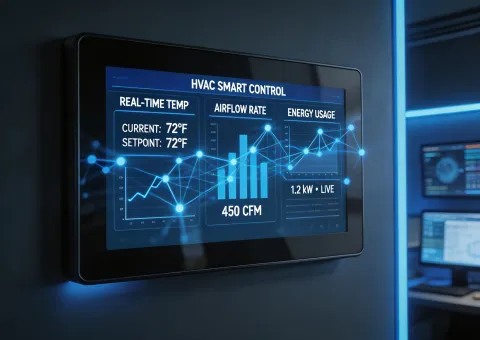
McQuay Climate invests over 8% of annual revenue in R&D, operating four advanced testing laboratories focused on compressor efficiency, refrigerant optimization, IoT connectivity, and AI-driven building management.
Our proprietary machine learning algorithms analyze over 200 operating parameters in real time, predicting load changes 30 minutes ahead and proactively adjusting compressor staging, valve positions, and fan speeds. Field deployments demonstrate 12-18% additional energy savings beyond conventional PID control, while reducing compressor cycling by 40%.
The system continuously learns from historical operational data, weather forecasts, and occupancy patterns, creating facility-specific optimization profiles that improve over the first 90 days of operation.
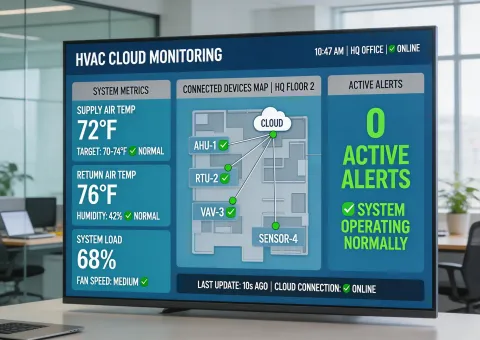
Every McQuay Climate system ships with embedded IoT modules supporting BACnet IP, MQTT, and REST API protocols. Our cloud platform aggregates data from over 12,000 connected units globally, providing fleet-wide performance benchmarking, automated fault detection, and remote firmware updates.
Facility managers access real-time dashboards, energy consumption trending, and automated maintenance alerts via web browser or mobile app — transforming reactive maintenance into data-driven asset management.
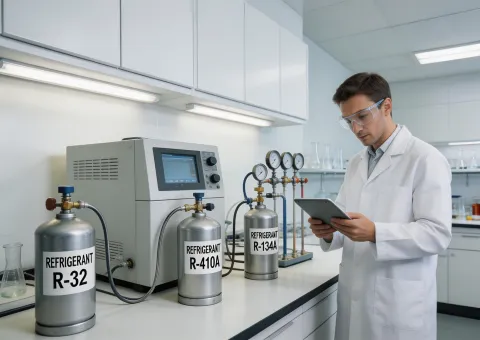
Our dedicated refrigerant research laboratory tests and validates low-GWP alternatives across all product lines. Current programs include transcritical CO2 (R-744) chillers for commercial applications, R-290 propane heat pumps with charge-minimized heat exchangers, and R-1234ze-based centrifugal compressor systems.
By 2027, 100% of our product portfolio will offer at least one option with GWP below 150, fully aligned with EU F-Gas phase-down schedules, EPA SNAP approvals, and Kigali Amendment timelines.
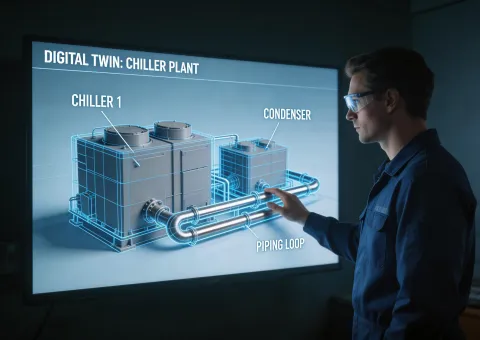
Our digital twin platform creates physics-based virtual replicas of complete chiller plants, enabling engineers to simulate performance across varying load profiles, ambient conditions, and control strategies before physical installation. Virtual commissioning reduces on-site startup time by 35% and identifies potential integration issues weeks before equipment arrives.
Post-installation, the digital twin remains synchronized with the physical system, enabling continuous optimization and "what-if" scenario analysis for future expansion planning.
The global phase-down of high-GWP HFCs under the Kigali Amendment and EU F-Gas Regulation (517/2014, revised 2024) creates a critical decision point for every facility. There is no single "correct" refrigerant — each pathway involves measurable trade-offs.
Zero or near-zero GWP (R-744 GWP = 1, R-290 GWP = 3), no patent dependencies, and lower operating costs at scale. Transcritical CO2 systems are increasingly viable in climates with ambient temperatures below 35°C. However, R-717 is toxic (ASHRAE B2L classification) and requires dedicated machinery rooms with leak detection. R-290 is flammable (A3 classification), limiting charge sizes to approximately 150g per circuit under IEC 60335-2-89 without additional safety measures.
Near drop-in compatibility with existing HFC infrastructure reduces retrofit costs by 40-60% versus natural refrigerant conversions. GWP values range from 1 (R-1234ze) to 466 (R-454B). Minimal technician retraining required. However, HFOs decompose into trifluoroacetic acid (TFA) in the atmosphere, a persistent environmental pollutant whose long-term impact remains under scientific review. Patent-protected supply chains may create cost uncertainty as HFC quotas tighten.
Our approach: McQuay Climate offers both pathways. Our engineering team provides refrigerant lifecycle cost analysis specific to your climate zone, facility type, and regulatory jurisdiction — helping you select the option with the strongest 15-year total cost of ownership, not the lowest upfront price.
The choice between air-cooled and water-cooled chillers depends on installation constraints, operating load profile, and total lifecycle cost — not product preference.
| Selection Dimension | Air-Cooled Chillers | Water-Cooled Chillers |
|---|---|---|
| Full-Load COP | 2.8 – 3.5 | 5.0 – 6.2 |
| IPLV (kW/TR) | 0.65 – 0.85 | 0.35 – 0.50 |
| Installation Cost | Lower (no cooling tower, fewer ancillaries) | Higher (cooling tower, water treatment, condenser water piping) |
| Water Consumption | Zero | 3–5 liters per kWh rejected (evaporative losses) |
| Equipment Life | 15–20 years typical | 20–30 years typical |
| Best Fit | Water-scarce regions, rooftop installations, projects <500 TR | Large campuses, data centers, process cooling >500 TR |
Both architectures are available across our chiller range. Our application engineers provide site-specific energy modeling using TMY3 weather data to quantify lifecycle cost differences for your specific project.
Transparent engineering means acknowledging where systems perform optimally and where alternative approaches may be more suitable.
Transcritical CO2 (R-744) chillers achieve optimal COP in ambient temperatures below 35°C. In tropical regions with sustained ambient above 38°C, COP drops by 15-25% compared to temperate climates. For such applications, R-290 or HFO-based systems may deliver better annual energy performance. Our engineering team models site-specific TMY3 weather data before recommending CO2 systems in warm climates.
Our AI-driven control algorithms require 60-90 days of operational data to fully calibrate facility-specific optimization profiles. During this initial learning period, energy savings average 5-8% rather than the steady-state 12-18%. Buildings with highly irregular occupancy patterns or frequent setpoint overrides may experience extended calibration periods of up to 120 days.
R-290 (propane) heat pumps are classified A3 (flammable) under ISO 817. Current regulations (IEC 60335-2-89, EN 378) restrict refrigerant charge to approximately 150g per circuit in occupied spaces without additional safety measures. This limits R-290 to smaller capacity modules; large-capacity applications require multi-circuit designs or dedicated machinery rooms with gas detection systems.
Our cloud monitoring platform requires a stable internet connection with minimum 2 Mbps upload bandwidth per 50 connected devices. Facilities with restricted network policies, air-gapped industrial networks, or locations with intermittent connectivity will need on-premises gateway solutions (available as an option) rather than direct cloud connectivity. Historical data buffering is limited to 72 hours during network outages.
Ready to discuss how our innovation platforms can optimize your facility's performance? Our application engineers are standing by.